


Northline Windows & Doors
Publisher
With so much attention going toward triple pane windows, it’s easy to get the impression that double pane has somehow become the “old” option. That’s not really the case.
A well-made double pane window can still be a very practical choice for an Ottawa home. Two panes of glass create a sealed, insulated space between your home and the outdoors, giving you a significant improvement over the older windows many homeowners are replacing today. The more interesting question is whether you actually need to go beyond it.

If you have a large living-room window where you spend every evening, a bedroom that always feels colder in January, or you’re particularly concerned about condensation and cold-weather comfort, there may be good reasons to consider triple pane. But that doesn’t mean adding a third pane to every window automatically gives you better value. Sometimes double pane is simply enough.

It can be especially appealing when you’re trying to balance window performance with the overall cost of replacing several openings at once. Instead of paying for the highest-performing glass package simply because it’s available, it makes more sense to look at your home, the rooms you actually use and what you’re hoping to improve about your existing windows.
And that’s really where the double pane vs. triple pane conversation should start. Not with which option has more glass, but with which one makes more sense for your home.
Below, we’ll look at what actually changes when you move from double to triple pane, where double pane windows can still be a smart choice in Ottawa, and what you should know about their performance and lifespan before deciding.


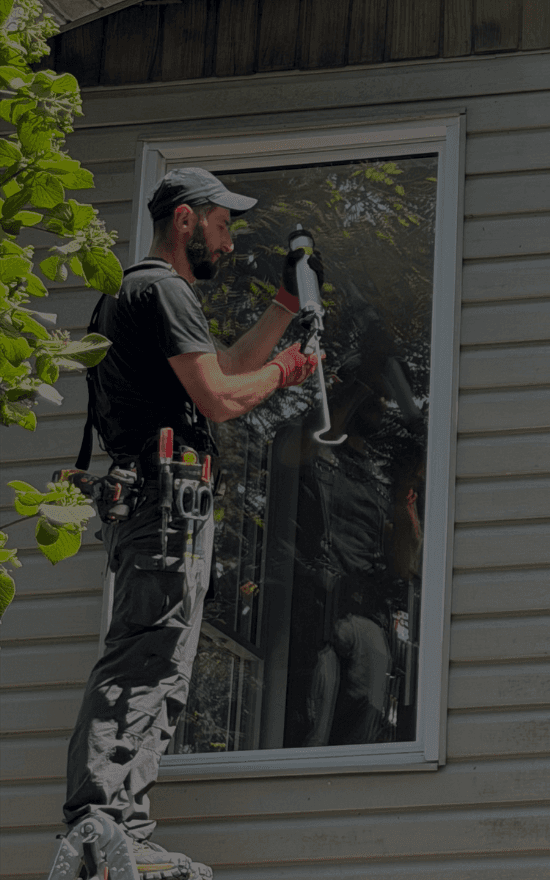
Double Pane Windows
Double pane windows have been a standard choice for residential window replacement for a reason. The idea is relatively simple — two panes of glass separated by a sealed space — but there’s more happening inside that glass unit than you might realize.
For Ottawa homeowners, the important question isn’t whether double pane has the most glass available. It’s how that window performs once it’s separating a comfortable room from a cold January afternoon.
What Are Double Pane Windows?
A double pane window uses two panes of glass with a sealed, insulated space between them. That additional layer helps slow the movement of heat through the window compared with older single-pane glass.
It’s a fairly straightforward design, but it can make a meaningful difference in how the area around a window feels. If you’re replacing older windows that become noticeably cold during the winter, double pane gives you another layer between the room and the conditions outside.
And double pane refers specifically to the glass unit. You can still use it across different window styles and configurations throughout the home.
What’s Between the Two Panes of Glass?
That gap between the glass isn’t simply empty space.
Depending on the glass package, the sealed cavity can contain an insulating gas such as argon. Combined with the glass itself, Low-E coatings and the spacer system around the edge, that space helps reduce heat transfer through the insulated glass unit.
This is why two windows described as “double pane” aren't necessarily identical. The glass package is one part of a larger system that also includes the frame, seals, weatherstripping and installation.

Are Double Pane Windows Energy Efficient?
A well-made double pane window can still be an energy-efficient choice, particularly when it’s replacing older or poorly performing windows.
The important thing is not to treat the number of panes as the only measure of efficiency. Glass coatings, gas fills, the frame, weather sealing and installation can all influence the performance of the finished window.
If you’re planning a larger window replacement, this becomes especially important. Instead of automatically choosing the highest-performing glass package for every opening, you can look at the house room by room and decide where additional performance is actually worthwhile.
What Is the R-Value of a Double Pane Window?
R-value is a way of describing how well something resists the movement of heat. The higher the R-value, the greater the resistance to heat transfer.
For double pane windows, that number can vary depending on the window style. That’s worth knowing because two windows using the same general glass package may not have exactly the same overall thermal performance.
Window Style | Double Pane R-Value | Triple Pane R-Value |
|---|---|---|
Casement | 3.85 | 5.88 |
Awning | 3.85 | 5.88 |
Double Hung | 3.57 | 5.88 |
Single Hung | 3.57 | 5.88 |
Sliding | 3.57 | 5.88 |
The difference is useful when you're comparing double and triple pane, but R-value shouldn't be the only number that makes the decision for you. Window size, location in the home, comfort, budget and the performance you're trying to achieve all matter too.
For many Ottawa homes, double pane can still provide a practical level of insulation without automatically moving every opening to triple pane.
What About U-Value?
R-value isn't the only number used to describe window performance. U-value measures the rate of heat transfer through the window, so this time the scale works in the opposite direction: lower is better.
Window Style | Double Pane U-Value | Triple Pane U-Value |
|---|---|---|
Casement | 0.26 | 0.17 |
Awning | 0.26 | 0.17 |
Double Hung | 0.28 | 0.17 |
Single Hung | 0.26 | 0.17 |
Sliding | 0.28 | 0.17 |
The easiest way to remember it is: R-value tells you about resistance to heat flow; U-value tells you about the rate of heat transfer. Both help describe thermal performance, just from different directions.
What Is Solar Heat Gain Coefficient?
Windows don't only deal with heat trying to escape your home. They also allow energy from sunlight to enter through the glass.
Solar Heat Gain Coefficient (SHGC) describes how much solar heat is transmitted through a window. A lower number means less solar heat is entering through the glass, while a higher number allows more of that solar energy through.
Window Style | Solar Heat Gain Coefficient |
|---|---|
Casement | 0.46 |
Awning | 0.46 |
Double Hung | 0.51 |
Single Hung | 0.50 |
Sliding | 0.58 |
That doesn't mean the lowest number is automatically the “best” window. Where the window faces, how much direct sunlight the room receives and what you're trying to accomplish all matter. A sunny living room and a shaded bedroom don't necessarily present the same priorities.
Double Pane Doesn’t Limit Your Window Style
Choosing double pane doesn't mean choosing one particular type of window. It describes the glass package, leaving plenty of room to decide how each opening should actually look and function.
Double pane glass can be used in everything from casement windows that provide ventilation to large picture windows designed around an uninterrupted view.

There’s plenty of room to personalize the appearance as well. Depending on the window configuration, white, black, charcoal and other frame colours can help the window blend into the home or create more contrast. Grille patterns and hardware finishes such as white, black, brushed nickel or satin metallic tones can add another layer of detail.
That’s worth remembering when comparing your options: double pane tells you what’s happening between the glass. It doesn’t decide what the finished window has to look like.


Double Pane Longevity
Double pane windows don’t have an expiry date stamped on the frame. Some can continue performing well for many years, while others start showing problems much sooner.
Instead of replacing them based on age alone, pay attention to how the glass, seals, frame and hardware are holding up. Your windows will usually give you a few clues when something has started to change.
Fog or Condensation Between the Glass
Moisture between the two panes of glass is one of the clearest signs that something isn't working as intended.
The insulated space between the panes is supposed to remain sealed. If that seal fails, moisture can enter the glass unit and create a cloudy or fogged appearance that may come and go with changes in temperature.
Wiping the window won't fix it because the moisture isn't on a surface you can reach.

A failed seal doesn't always mean the entire window needs immediate replacement, but it's certainly worth having it assessed.
Drafts, Difficult Operation & Worn Hardware
Feeling cold near a window doesn't automatically mean the double pane glass has failed. Worn weatherstripping, deteriorated seals or gaps around the frame can also contribute to drafts.
Pay attention to operation as well. A window that has become difficult to open, won't close properly or refuses to lock may have worn hardware or other components that need attention.
Sometimes these issues can be repaired. When you're dealing with persistent drafts, failed seals and operating problems across several older windows, however, a larger window replacement can start making more sense than continuing with individual repairs.

Replace Based on Condition, Not a Calendar
So, how long do double pane windows last?
There isn't one useful number that applies to every home. Installation quality, exposure to weather, materials, maintenance and everyday use can all influence how a window ages.
Instead of circling a replacement year on the calendar, look at what the windows are actually telling you. Fog between the panes, recurring drafts, difficult operation, visible deterioration and rooms that have become noticeably uncomfortable are much better reasons to start considering replacement.
And if your double pane windows are still sealed, comfortable and working properly? There may be no reason to replace them simply because they've had a few birthdays.
